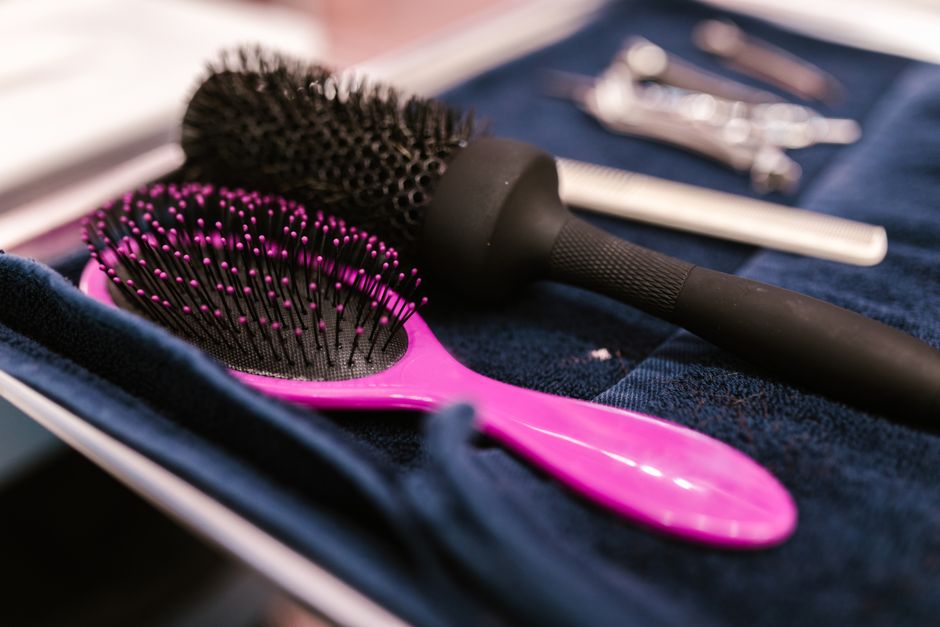
A hairbrush can look right on the shelf and still feel wrong in your hair. It might skim over thick sections, flatten fine roots, or pull apart curls you wanted to keep defined. Learning how to choose a hairbrush for your hair type starts with two questions: what does your hair need, and what do you want the brush to do? A tool for loosening tangles has a different job from one used to shape a blowout. Match those jobs first, then consider bristle spacing, flexibility, and size.
Look beyond your curl pattern
Your curl pattern matters, but it does not tell the whole story. Fine hair describes the thickness of individual strands; low density describes having fewer strands across the scalp. You can have fine strands and a lot of hair, or coarse strands with less overall density. These combinations change how easily a brush moves through a section.
Consider length and condition, too. Long hair needs careful work through the ends, while short hair often benefits from a smaller brush that reaches close to the roots. Hair that is bleached, frequently heat styled, or prone to snapping calls for gentle handling, whatever its natural texture.
- Strand thickness: Do individual hairs feel fine, medium, or coarse?
- Density: Does your brush reach through a small section, or mostly travel over its surface?
- Pattern: Are you preserving waves, curls, or coils, or styling a smoother finish?
- Main task: Do you need detangling, everyday smoothing, or shape during drying?
Understand the main brush designs
Flexible detangling brushes
These usually have spaced pins that bend as they meet resistance. They can be useful for working through knots in small sections, provided the pins have smooth edges and do not scrape your scalp. Flexibility is helpful, but a brush that bends is not permission to pull harder. Check whether the model is intended for wet hair, dry hair, or both.
Paddle and cushioned brushes
A paddle brush has a broad surface that can help with smoothing longer sections. A cushioned base allows some movement beneath the pins or bristles. Look at both features separately: a large paddle with densely packed bristles behaves differently from one with widely spaced pins. A broad head may feel awkward on a short cut or around the hairline.
Bristle and mixed-bristle brushes
Densely packed natural or synthetic bristles are often better suited to surface smoothing than tackling knots. Mixed-bristle designs combine bristles with longer pins to reach farther into a section. Neither construction suits everyone. If the brush catches at the ends or requires repeated pressure to move, use a different tool for detangling first.
Round and vented brushes
Round brushes help create bend, root lift, or a curved finish while blow-drying. Larger barrels generally produce a broader bend; smaller ones give more pronounced shaping. Vented brushes allow air through openings in the head and can help guide hair during drying. Heated airflow can make some barrels hot, so follow the tool instructions and keep the dryer moving.
Match the brush to your hair
Fine strands or low-density hair
Start with lightweight tools, flexible pins, and gentle pressure. A small cushioned brush or flexible detangler may be easier to control than a heavy paddle. For smoothing already detangled hair, soft bristles can be useful if they glide comfortably. Avoid choosing stiff pins simply because you want more volume; root lift depends on styling technique as well as the brush.
Thick or densely packed hair
Look for pins long enough to move through a manageable section and enough space between them that hair does not become packed into the brush. A sturdy handle helps with control, but stiffness alone does not make a tool suitable. Sectioning is often more effective than buying a larger brush. If the surface looks smooth while knots remain underneath, work in smaller sections.
Straight hair
A flexible detangler can handle knots, while a paddle or cushioned brush can help arrange the lengths afterward. Choose the head size according to your cut and how much control you need. Long straight hair does not automatically need dense bristles: if your ends catch, wider spacing and fewer passes may feel better.
Wavy hair
Decide whether you want to keep the wave pattern or brush it into a softer shape. Dry brushing can separate waves and change their appearance. If definition is your priority, try gentle detangling with conditioner providing slip during washing, using fingers, a wide-tooth comb, or a suitable detangling brush. Once styled, you may only need to adjust individual sections with your fingers.
Curly and coily hair
For many curls and coils, detangling works best in sections while the hair is wet and slippery with conditioner. Begin with fingers if that gives you more control, then use a wide-tooth comb or flexible, spaced-pin brush as needed. Support each section and work gradually from the ends upward. A brush used to arrange curl clumps is a styling tool; it should not be forced through unresolved knots.
Check the details before choosing
Inspect pins for rough seams, sharp edges, or damaged tips. Gently press them against your palm to assess how they feel, without assuming that comfort on your hand guarantees comfort on your scalp. Check that the handle is easy to hold and that the head suits the areas you need to reach. For round brushes, make sure you can release a small section easily.
Think about cleaning before you buy. Closely packed bristles can take more effort to clear, and some cushioned or wooden designs should not be soaked. Read the care instructions. A tool that fits your routine is more useful than one with extra features you will rarely use.
Use a gentle technique with any brush
- Divide your hair: Make sections small enough that you can feel where the brush meets resistance.
- Start at the ends: Loosen the lowest tangles before gradually working higher.
- Support the section: Hold the hair above the area you are detangling to limit pulling at the roots.
- Pause at a snag: Set the brush aside and ease the knot apart with your fingers instead of dragging through it.
- Stop when the job is done: There is no need to reach a fixed number of strokes.
Wet hair needs careful handling. For straight hair, letting it dry somewhat before gentle detangling may suit you; curls and coils often need the slip of conditioner while wet. Let comfort, your hair’s behavior, and the tool’s instructions guide you. Persistent scalp pain, irritation, unusual shedding, or ongoing breakage deserves advice from a dermatologist or doctor.
Keep a small, useful brush collection
You may need only one detangling tool and, if you heat style, a separate shaping brush. Remove trapped hair regularly and clean each tool according to its instructions, allowing it to dry fully. Replace brushes with rough pins, damaged tips, or cracked surfaces that catch hair. The right choice moves through manageable sections comfortably and helps you achieve your preferred finish without repeated pulling.
