
You are standing by the door in a thick sweater, wide-leg trousers and boots, but the coat makes the whole outfit look heavier than it felt five minutes ago. The shoulders seem too broad, the hem stops at the wrong point and the waist disappears. That problem usually has less to do with color than with silhouette. A winter coat is the largest shape in an outfit, so its line controls what the eye notices first. Cocoon, wrap and peacoat shapes solve different proportion problems. The right choice can make the same knitwear, trousers and boots look sharper without adding more clothes.
Why Coat Silhouette Changes an Outfit Before Color Does
The first-principles problem is simple: winter clothing adds volume. A sweater creates width across the torso, a scarf adds height near the face and boots add visual weight below the knee. The coat has to organize all of that. If its outline fights the layers underneath, the outfit looks crowded even when each item fits on its own.
Warmth creates volume, so the outer line must control it
A straight, narrow coat can look polished over a thin shirt and awkward over a chunky knit. A rounded cocoon shape gives the torso room, but it needs a clean shoulder and a controlled hem to stop the body from looking shapeless. A wrap coat uses a belt to create a visible center line. A peacoat uses double-breasted structure, a strong lapel and a shorter hem to keep bulk close to the upper body.
Length matters as much as width. A hem that ends 5 to 10 centimetres above the widest part of the calf often creates a cleaner leg line than one that stops directly at that point. A shorter coat can work with wide trousers when the waist or hip line stays clear. A longer coat can balance a fitted lower half, but too much fabric at both the torso and hem can make the outfit look dense.
Read the coat as a frame around the outfit
Look at the coat from a distance of two or three metres. Ignore the buttons and fabric for a moment. Can you see where the shoulders end, where the waist sits and where the legs begin? Those three points form the frame. If all three disappear, the coat needs either more structure or a clearer fastening point.
Keep one area relaxed and make another area precise. A rounded coat with narrow trousers works because the lower line is clean. A belted coat with a full skirt works because the waist interrupts the volume. A short peacoat with wide trousers works when the top half stays compact. This is why a silhouette can change an outfit before color, texture or trend details have any chance to speak.
Choose the Silhouette by the Problem You Need to Solve
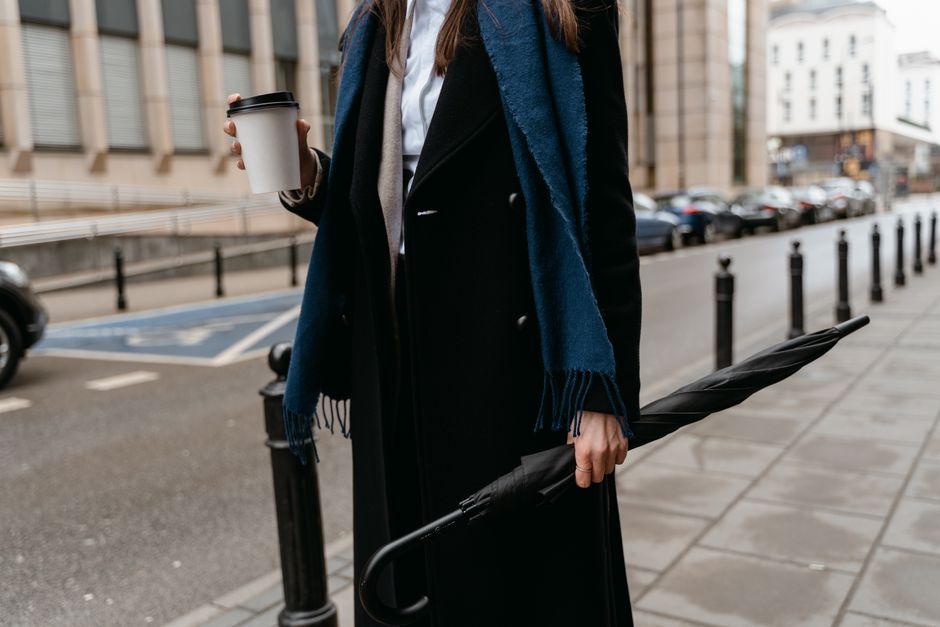
Start with the outfit failure, then choose the shape
- If thick layers feel trapped: choose a cocoon shape with at least 8 to 12 centimetres of ease across the chest compared with your lightest outfit. The shoulder should still end close to the shoulder bone.
- If the torso looks lost: choose a wrap shape and place the tie slightly above the natural waist. A visible overlap of 4 to 6 centimetres keeps the front secure without pulling across the ribs.
- If wide trousers make the outfit feel bottom-heavy: choose a peacoat or another compact short shape. Keep the hem above the widest point of the trousers so the eye sees a deliberate break.
- If the coat makes the shoulders look broad: avoid a large lapel and heavy double-breasted front. A quieter cocoon shoulder or a narrow wrap front will reduce horizontal emphasis.
- If sitting is part of the daily routine: test the coat seated, not only standing. A long wrap front may bunch at the waist, while a shorter peacoat may ride up across the back.
The strongest choice is the one that fixes the repeated problem, not the one that looks most dramatic on a hanger. Take the two outfits worn most often and check the coat over both. If the shape solves one outfit but creates a new problem with the other, it is too narrow a choice for the wardrobe.
Do not use a belt to rescue a coat that is already too tight. Do not size up a peacoat until the shoulder seam drops several centimetres past the shoulder bone. Do not assume a longer hem adds elegance; it can also hide the leg line and make practical movement harder. Clear measurements beat vague promises about versatility.
The Cocoon Coat Wins When You Want Softness Without Sloppiness
The cocoon is the best choice for thick winter layers and relaxed outfits. Its value comes from controlled room, not from appearing oversized. The shoulder stays fairly neat while the body curves outward and narrows again near the hem. That shape gives a sweater space without making the whole outfit look like a rectangle.
Make the rounded line look intentional
Pair the cocoon with one clean vertical element: straight trousers, a narrow skirt, a long scarf worn close to the body or boots with a simple shaft. That vertical line stops the rounded torso from taking over. A hem that sits around mid-thigh to just above the knee often gives enough coverage while leaving the legs visible. For a longer cocoon, keep the lower half simple and avoid stacking volume at the ankle.
Know when the cocoon becomes a mistake
The common failure is adding softness everywhere. A loose coat over a loose sweater, wide trousers and bulky shoes creates four competing shapes. The coat may feel comfortable, but the outfit loses direction. Another mistake is choosing a dropped shoulder that ends far beyond the natural shoulder line. The cocoon should have room through the body, not a collapsed frame.
Check the side view. You should be able to sit, lift the arms and close the front without the back pulling. Then look at the hem from the front and side. If it flares sharply at the widest point of the hips, the shape may need a firmer fabric or a slightly different length. The verdict is clear: the cocoon earns its place when the wardrobe relies on heavy knits, practical layering and calm proportions. It is the wrong answer for anyone who wants a sharply defined waist in every outfit.
The Peacoat Is Not the Safe Choice for Every Wardrobe

The peacoat is the best silhouette for balancing a wide or fluid lower half, but it is not the universal winter answer. Its short hem, broad lapel and double-breasted front create a compact upper block, so it works with wide-leg trousers, long skirts and denim that needs a clean top edge. The same structure can crowd a fuller chest, shorten a long torso or feel restrictive over thick layers. Choose it when the outfit needs upper-body definition and when most daily movement happens above the knee. Skip it when warmth requires several bulky layers, when a longer hem is needed for wind protection or when the wardrobe already contains many strong horizontal details. Keep the neck area open, let the lapel remain visible and use one long vertical element below it.
Build Three Outfits From One Silhouette Decision
Use a simple three-step outfit test
- Start with the base: put on the outfit that most often causes trouble. Mark the widest point of the body and the point where the legs begin. The coat should either contain the width or redirect the eye toward a cleaner line.
- Add one counter-shape: pair a cocoon with a narrow lower line, a wrap with a relaxed but not oversized lower line, or a peacoat with a fluid lower line. The contrast makes the outfit look planned.
- Check movement: walk, sit, raise both arms and close the front. Leave enough room for two winter layers without forcing the buttons or belt. A coat that looks right only while standing still is not solving the daily problem.
Three practical outfit formulas
For the cocoon, use a thick knit, straight trousers and a simple boot. Keep the scarf close to the neck and let the coat provide the rounded shape. For the wrap, use a dress or fine knit with a skirt, place the tie slightly above the natural waist and keep the shoe line long. For the peacoat, use wide-leg trousers or a fluid skirt, leave the neckline visible and keep the accessories narrow near the face.
These formulas do not require a new trend cycle. They rely on proportion, measured ease and a clear answer to the question: where should the eye travel first?
Return to the doorway problem. If the thick sweater made the torso feel crowded, the cocoon gives it room. If the body disappeared under the layers, the wrap restores a center line. If wide trousers made the outfit feel heavy below, the peacoat brings structure back to the top. The coat no longer swallows the outfit because its silhouette has a job.
