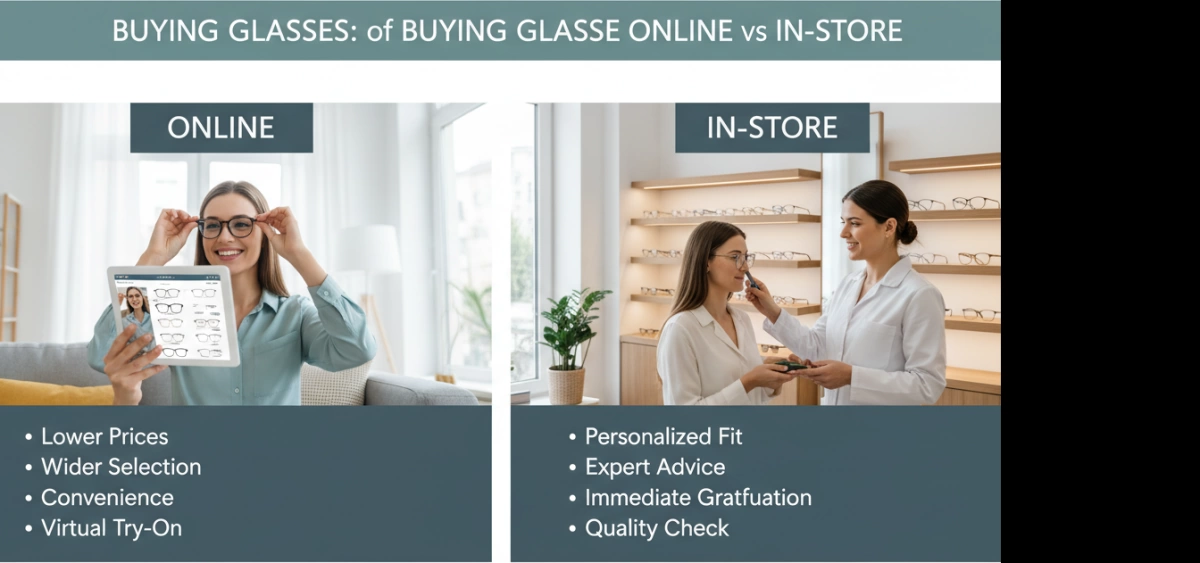
Choosing between buying glasses online or visiting a brick-and-mortar optical shop isn’t just about price. It’s about finding the right balance between convenience, frame fit and adjustment, and prescription accuracy. While online eyewear offers tempting savings and a wide selection, it comes with challenges like pupillary distance measurement (PD) and limited physical trial. On the other hand, in-store purchases provide hands-on service from a licensed optician, precise fitting for progressive lenses, and reliable aftercare—but often at a higher cost. This guide breaks down the pros and cons of buying glasses online vs. in-store, helping you decide what fits your budget, vision complexity, and style needs best.
The Case for Buying Glasses Online (The Digital Route)
The Primary Draw: Cost Savings
One of the biggest reasons people choose to buy glasses online is cost savings. Online retailers don’t have the overhead costs of brick-and-mortar optical shops — no rent for a physical location or large sales staff to pay. This lets them offer frames and lenses at much lower prices.
- Lower overhead means cheaper prices: Fewer middlemen and no costly storefront.
- Transparent lens pricing: Online shops often list costs for lens upgrades like high-index lenses or blue light blocking coatings separately, so you see exactly what you’re paying for.
- In contrast, in-store pricing can bundle these extras, sometimes hiding the true cost.
Convenience and Selection
Buying online also scores high for convenience and variety.
- Browse thousands of styles easily, unlike the limited wall space of a traditional shop.
- Shop anytime, without feeling pressure from in-store sales associates.
- This gives you more freedom to compare and choose what fits your style and budget best.
Technology Limitations & Solutions
Modern technology helps bridge the online fitting gap but isn’t perfect.
- Virtual try-on technology lets you see how frames look on your face through your webcam or smartphone, but sizing can feel off since it’s two-dimensional and can’t perfectly mimic real-life fit.
- Some brands offer home try-on programs, where you order a few frames to try at home before deciding. This “try before you buy” model eases the uncertainty online shopping brings.
The “Hidden” Hurdles of Buying Online
Still, there are challenges with the digital route.
- Pupillary Distance (PD) problem: Customers often struggle to accurately measure their PD, which is crucial for lenses to align properly with your eyes.
- Without a physical fitting, glasses may sit crooked or slip down your nose, since there’s no professional frame fit and adjustment available right away.
Buying glasses online offers clear benefits—mainly cost and convenience—but it requires careful attention to measurements and an understanding of the technology limitations involved.
The Case for Buying In-Store (The Traditional Route)
Professional Expertise (The Optician Factor)
One major advantage of buying glasses in-store is the access to a licensed optician. These professionals measure segment heights precisely and fit frames perfectly to your unique facial structure. If you experience any vision issues, they can troubleshoot immediately—something that’s hard to replicate online. This hands-on expertise ensures your glasses truly suit your needs.
Prescription Accuracy & Complexity
For complex prescriptions, especially with high astigmatism or strong corrections, in-store purchases are safer. Opticians verify your prescription in person, reducing the risk of errors. Progressive lenses require exact measurements like segment height, which can be very challenging to capture accurately through a webcam. This precision is crucial to avoid headaches and blurry vision later.
The Tactile Experience
Buying in-store lets you feel the weight and quality of frames firsthand. Materials like acetate feel sturdy and comfortable, unlike some cheap plastics you might get online. You can also see the true color of frames and check how well they match your skin tone, helping you find a style that suits you perfectly.
After-Care and Warranty
An in-store purchase usually comes with ongoing support, like free adjustments for the life of your glasses. If your prescription feels off or if the frames need tweaking, it’s easier to get returns or fixes, saving you hassle in the long run. This level of personalized after-care is tough to match with online orders.
For more insight on picking eyewear that matches your style and face, check out these helpful tips on how to enhance your work look that can complement your new frames.
Head-to-Head Comparison: The “Deal Breakers”
When deciding between buying glasses online or in-store, a few key deal breakers often make the choice clearer. Here’s how they stack up:
| Factor | Online Glasses | In-Store Glasses |
|---|---|---|
| Price | Typically cheaper base price due to lower overheads and transparent pricing on single vision lenses and coatings like blue light blocking. | Often more expensive upfront, but vision insurance benefits are easier to apply here, with many stores offering direct billing to insurers. |
| Speed | Shipping can take 2 weeks or more, depending on location and supplier. | Many optical shops offer 1-hour labs for fast turnaround, perfect if you need glasses immediately. |
| Lens Quality | Mostly generic lenses; fewer options for premium brands. | Access to branded lenses like Crizal, Zeiss, and Varilux, especially important for progressive lenses or complex prescriptions. |
| Risk Factor | Higher return rates, often due to issues like incorrect pupillary distance measurement or poor frame fit and adjustment. | Lower return rates because of professional fitting and immediate troubleshooting with a licensed optician. |
Choosing between the two often comes down to what matters more: budget and convenience or precise fit and premium lens options. If you value prescription verification and guaranteed quality, in-store remains a safe bet. For straightforward needs and savings, the digital route is attractive.
The Verdict: Who Should Buy Glasses Online vs In-Store?
Deciding between buying glasses online or in-store boils down to your prescription needs, budget, and preference for service.
Go Online If:
- You have a single-vision prescription — simple nearsightedness or farsightedness is easier to order online without the need for complex fitting.
- You want a backup pair or sunglasses — usually less costly and lower risk if the fit isn’t perfect.
- You’re on a strict budget — online retailers benefit from lower overhead costs and often offer better base prices on frames and lenses, including options like high-index lenses or blue light blocking coatings at a discount.
Go In-Store If:
- You wear progressive lenses, bifocals, or trifocals — precise measurements, especially pupillary distance and segment height, are crucial for these complex prescriptions.
- You have a high prescription (stronger than +/- 4.00) — the risk of improper fitting and vision problems is higher; professional verification is safer.
- You have hard-to-fit facial features — if you have a very narrow or wide face, or a low nose bridge, a licensed optician can ensure better frame fit and adjustment.
- You value personalized service over lowest price — face-to-face help with frame fit, prescription verification, and ongoing adjustments makes the in-store experience worth it.
Choosing the right buying route depends on your individual vision needs and lifestyle. For a thorough look at different eyewear styles and how to pick what fits you best, exploring fashion-focused guides like those on wearing Parisian styles can be helpful for inspiration beyond just the technical.
